SXSW 2026: Ben Wang Talks Mental Health, Awkwardness, and Finding Yourself in ‘Brian’
During the 2026 edition of South by Southwest, one of the most quietly compelling entries in this year’s Narrative Feature Competition is Brian, a coming-of-age story that trades spectacle for something far more uncomfortable — honesty.
Directed by actor-turned-director Will Ropp and written by Saturday Night Live writer Mike Scollins, Brian follows a teenager whose intelligence and capability are constantly overshadowed by his anxiety, social misfires, and inability to connect in the ways he desperately wants to.
In my conversation with the film’s lead, Ben Wang, we discussed the film’s approach to mental health, the role of awkwardness in storytelling, and what it means to truly learn to live with yourself — not as an idealized version of who you wish you were, but as you actually are.
Ben Wang first gained widespread recognition for his lead roles in the Disney+ film Chang Can Dunk and television series American Born Chinese, the latter of which he co-starred alongside Academy Award® winners Michelle Yeoh and Ke Huy Quan.
He was later selected from a worldwide search of more than 10,000 actors to star in Karate Kid: Legends. Wang also appeared in the film adaptation of Stephen King’s The Long Walk, and is set to star in the highly anticipated The Hunger Games: Sunrise on The Reaping as District 12 tribute Wyatt Callow.
Official SXSW Synopsis
It sucks to be Brian. He’s smart, funny, and capable, but his mental health issues make it hard for anyone to see it - especially when compared to his effortlessly cool older brother. At school, Brian harbors an unrequited crush on Brooke: she’s smart, kind, pretty… and very much his teacher. A disastrous drama club audition leads to yet another one of Brian’s trademark public meltdowns. Thus begins Brian’s search for his new “thing”. On paper he’s chosen the worst possible fit: running for class president. With help from his therapist and the new kid, Justin, Brian launches his high-stakes campaign and sparks a messy, exquisitely awkward journey toward self-acceptance.
Learning To Live With Yourself
At its core, Brian is not a story about overcoming mental illness — it’s about co-existing with it.
When I asked Wang about the film’s central message, his answer re-framed the entire narrative:
| “The story is not about [Brian] overcoming his illness. The story is about him learning to live better with it…and realizing that living can still be okay.”
It’s a deceptively simple idea, but one that gives the film its emotional weight.
From a clinical perspective, what stood out most is how accurately Brian reflects a reality many people experience but rarely articulate — the idea that mental health isn’t something you simply “fix,” but something you learn to navigate over time.
Rather than offering a clean resolution, Brian leans into the discomfort. The awkwardness isn’t something to be eliminated — it’s something to be understood.
Brian is the kind of film that doesn’t rely on big emotional moments to make an impact — instead, it finds its strength in the quiet, uncomfortable spaces that most people try to avoid.
What makes the film stand out is how honest it feels. The awkwardness isn’t exaggerated for comedic purposes, and Brian’s emotional struggles aren’t simplified into something easily resolved. Instead, Brian presents a version of growing up that feels grounded, messy, and real — especially for anyone who has ever felt out of place in their own life.
In a festival lineup often filled with louder, more sensational films, Brian stands out precisely because it refuses to be anything other than itself.

Ben Wang as Brian Ballard during a therapy session scene in Brian.
Crafting Brian as a Character
Throughout his career, Wang has portrayed a wide range of characters — from the introspective Jin Wang in American Born Chinese to the more outwardly confident Hank Olson in The Long Walk.
However, when it comes to Brian, Wang doesn’t see these roles as opposites.
| “I think they’re all on one spectrum,” Wang explained. “There are introverted kids like Jin on one side, and someone like Hank Olson on the other —but most characters fall somewhere in between.”
That perspective shapes how Wang portrays Brian - not as an extreme, but as a reflection of something familiar.
| “Every character I play has their own circumstances and realities. That’s what keeps it interesting for me.”
That attention to nuance is what prevents Brian from becoming a caricature. Instead, he feels grounded — someone whose struggles are specific, but who’s experience is widely recognizable.
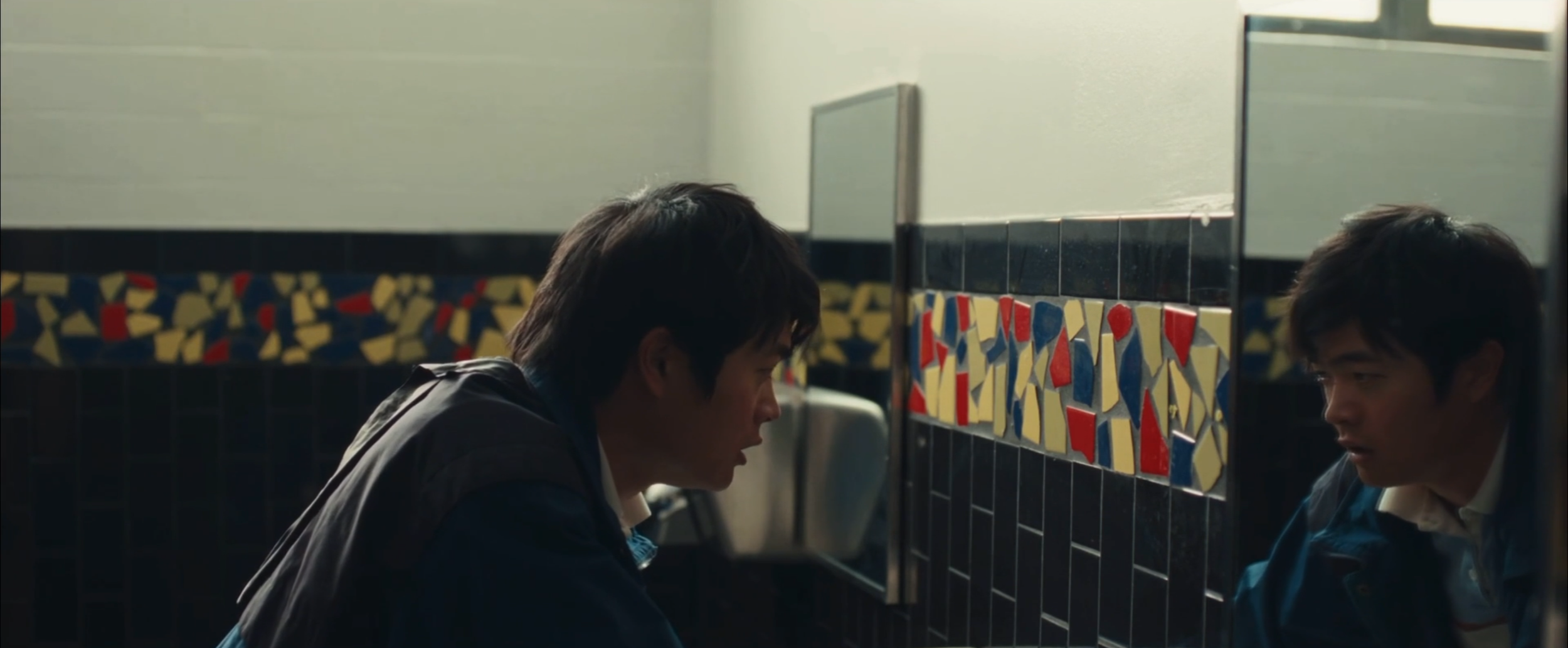
Ben Wang as Brian Ballard attempting to regain composure in Brian.
When Awkwardness Becomes Relatable
One of the film’s most effective qualities is how it balances uncomfortable humor with genuine emotional insight.
Brian’s social misfires often play out in ways that are painfully awkward — but never in a way that feels exaggerated or detached from reality.
Wang acknowledged that the character isn’t entirely removed from his own experiences growing up:
| “They said play a loser kid…I didn’t do any research. I just pulled it out. It’s not even that far back — sometimes I’m still that kid.”
It’s a comment that lands somewhere between humor and vulnerability, and it helps explain why the performance feels so authentic.
Rather than presenting Brian as someone to laugh at, the film invites the audience to recognize parts of themselves in him — even the parts they might not want to admit.

Ben Wang as Brian Ballard runs for senior class president.
The Hidden Side of Social Confidence
Toward the end of our conversation, I asked Wang what the quirkiest or most unusual thing about himself was. His answer revealed something deeper beneath the surface:
| “It’s not one thing. I’m actually completely socially inept.”
He elaborated:
| “You don’t understand the calculus that goes on inside my head just to make it look like I’m having a normal conversation.”
What Wang describes closely mirrors what many people with social anxiety experience — the invisible effort it takes to appear “normal” in everyday interactions.
It’s a kind of internal labor that often goes unnoticed, and Brian captures that dynamic with surprising clarity.
The film doesn’t just show awkwardness — it shows the effort behind it.

Ben Wang as Brian Ballard and Natalie Morales as Brian’s teacher Brooke in a scene from Brian.
Today’s Going To Be A Good Day
In a cultural landscape that often emphasizes transformation — becoming more confident, more successful, more “put-together” — Brian offers something quieter, but arguably more meaningful.
It suggests that growth isn’t always about becoming someone new.
Sometimes, it’s about learning how to live with who you already are.
Awkwardness, anxiety, and everything in between.
Brian doesn’t provide easy answers — and that’s exactly why it resonates. It’s a film that understands that healing isn’t linear, and that self-acceptance doesn’t come from eliminating struggle, but from learning how to move forward with it; and in a cultural moment that constantly pressures us to become someone else, Brian quietly asks a more difficult question: what if learning to live with who you already are is enough?”

Ben Wang (Brian), Will Ropp (Director) and Joshua Colley (Justin) on the set of Brian.
SXSW Film Details
Director: Will Ropp
Writer: Mike Scollins
Producers: Thomas Mahoney, Casey Hanley, Will Ropp
Cast: Ben Wang (Brian), Edi Patterson (Donna), Joshua Colley (Justin), Jacob Moskovitz (Teddy), Peyton Elizabeth Lee (Lisa), Thomas Barbusca (Travis), Sophia Macy (Ashley), Natalie Morales (Brooke), Randall Park (Richard), and William H. Macy (Dr. Reynolds)
Brian premiered at SXSW in Austin, Texas on Saturday, March 14th, 2026.
Disclosure: Wayward Fanboy participated in the SXSW press day for Brian and received early access to the film for review.